Qventus

AI teammates that take over hospital admin work and keep beds and ORs moving

Advanced
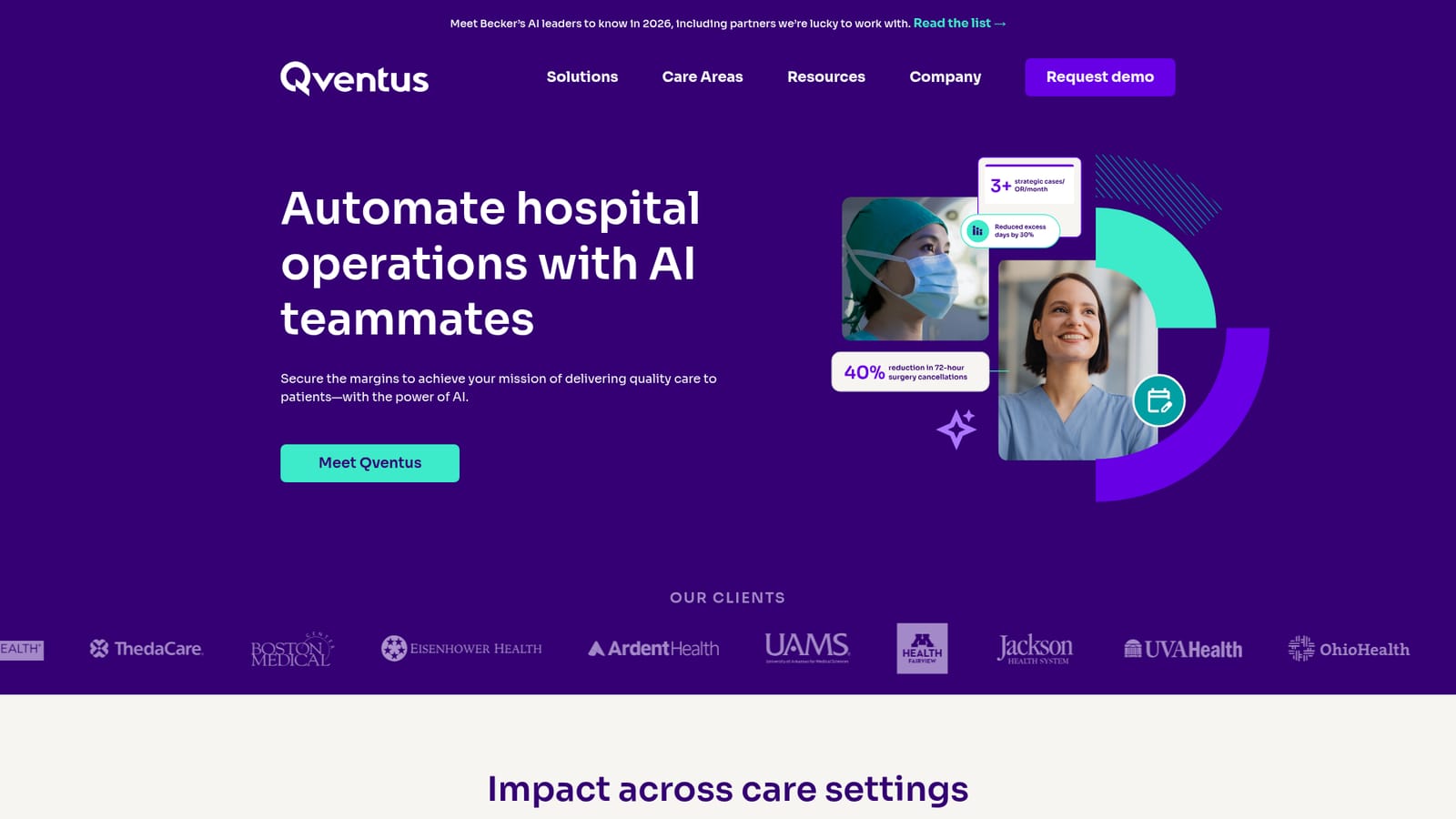
Screenshot of Qventus, AI teammates that take over hospital admin work and keep beds and ORs moving

What is Qventus?

Qventus is a proactive AI assistant tool. Qventus sells AI operational assistants to hospitals, aimed at surgical scheduling, pre-admission testing and discharge planning. The pitch is action rather than advice: assistants complete admin tasks so staff can focus on patients.

Qventus is an operations platform for hospitals and health systems, built around the idea of AI teammates that handle administrative work currently sitting with clinical staff. The homepage names its core promise plainly: automate hospital operations, protect margins, and free care teams to concentrate on patients. Rather than stopping at a recommendation or a dashboard alert, the system is described as taking immediate action on below-license administrative tasks, which is the distinction the company leans on most. The product is organized into three solution areas. Surgical Growth ties a hospital's growth strategy to daily scheduling so operating rooms fill with the cases that matter most, and the site claims three additional strategic cases per OR per month. Perioperative Care Coordination gives each pre-admission testing team member an administrative assistant that completes prep tasks, with a stated reduction in surgery cancellations of up to 40 percent. Inpatient Capacity focuses on early, accurate discharge planning to cut excess days by a claimed 15 to 30 percent and open capacity without adding work for care teams. This is not a self-serve tool. Buyers are hospital and health system leaders: surgical services directors, facility and capacity leaders, CIOs, and frontline operational managers. The reference logos on the homepage (Banner Health, Allina Health, Northwestern Medicine, among others) signal the scale of organization the platform is designed for, and the resource library leans heavily on CIO-level conversations about AI's role in patient care and operations. The practical question Qventus invites is whether an AI layer is worth buying above and beyond the EHR. One of its own resources frames the decision that way, and the Klas research note on capacity management gives buyers third-party validation to weigh. Teams comparing options should treat the published outcome figures as vendor claims to verify against their own baseline data, and should plan for a deployment effort rather than a quick signup.

How do you use Qventus?

  1. 1Review the three solution areas
    Start on the homepage and read the surgical growth, perioperative care coordination and inpatient capacity sections. Identify which of the three matches the operational bottleneck you are trying to solve.
    Qventus — Review the three solution areas
  2. 2Check references in your care setting
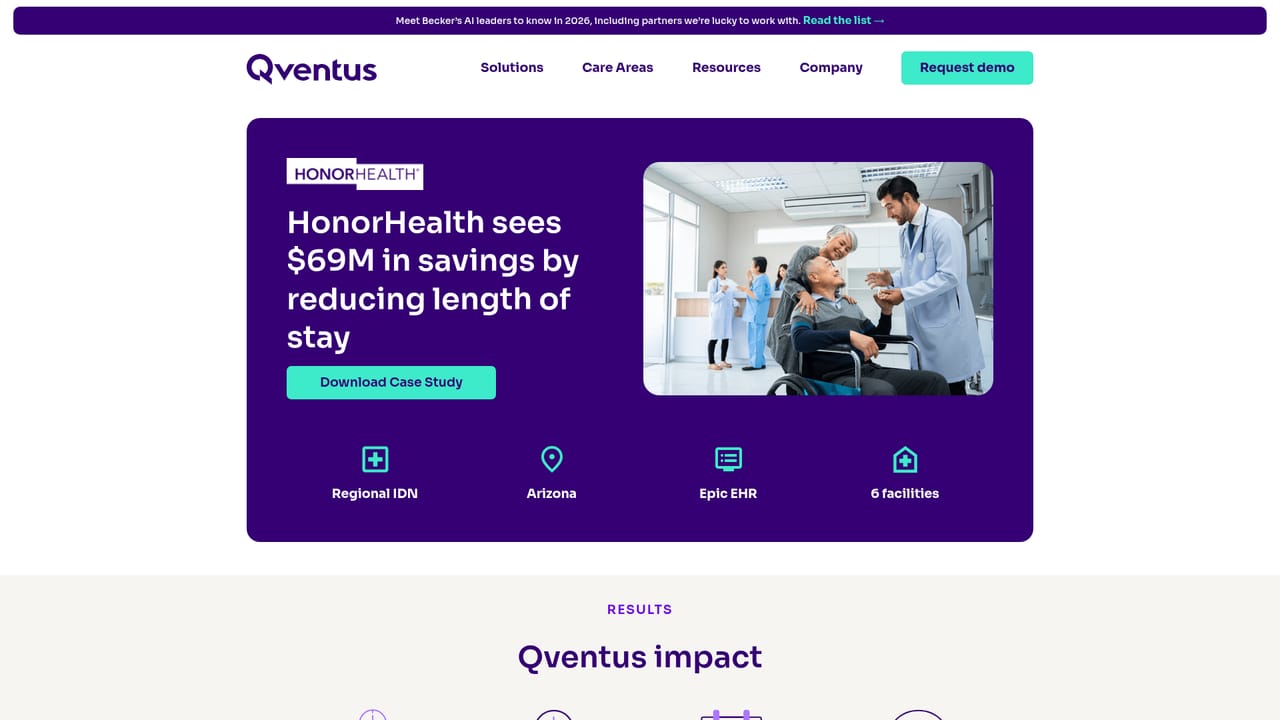
    Read the customer success stories for health systems similar to yours to see how the work was scoped and what changed. HonorHealth and Boston Medical Center are two of the published accounts.
    Qventus — Check references in your care setting
  3. 3Read the build versus buy guidance
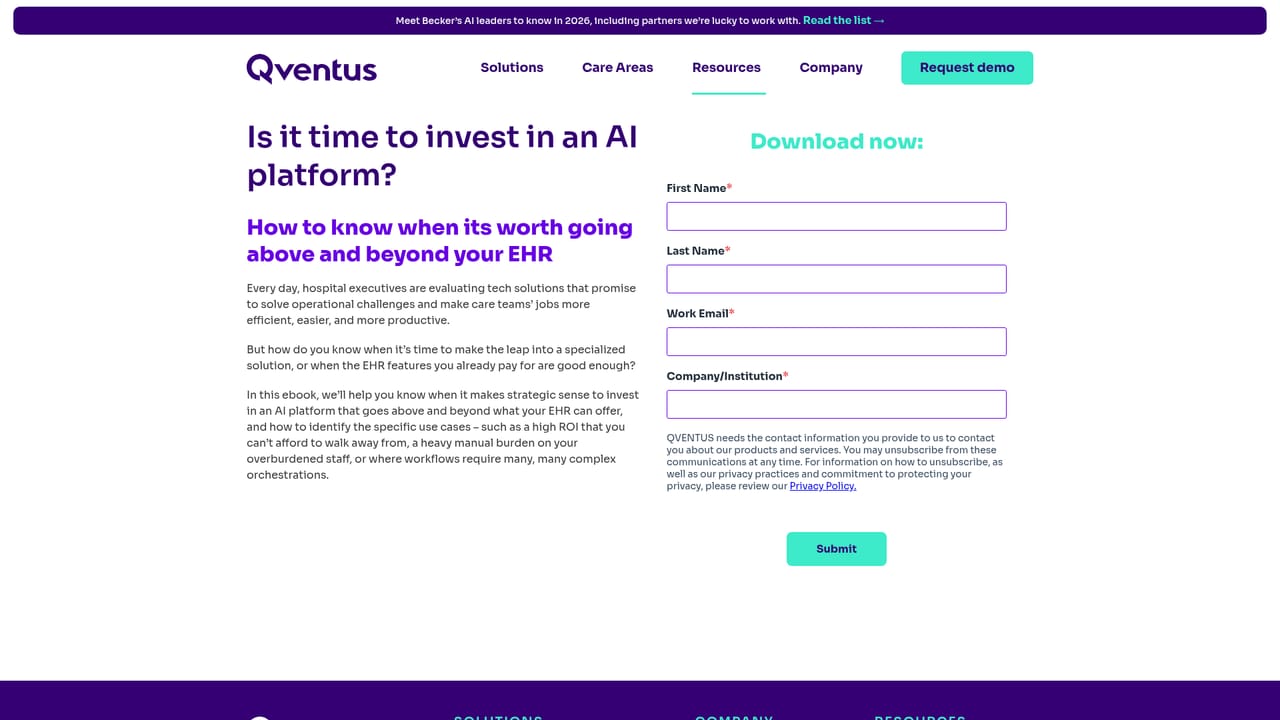
    The resource library includes a paper on deciding when an AI platform is worth going beyond the EHR. Use it to frame the internal business case before approaching vendors.
    Qventus — Read the build versus buy guidance
  4. 4Talk to the team about your baseline
    Contact Qventus with your current metrics for OR utilization, surgical cancellations and length of stay. Ask how the claimed improvements were measured at existing customers.
  5. 5Scope integration and rollout
    Once a solution area is chosen, work with the vendor on how the assistants connect to your existing systems and which teams are onboarded first. This planning happens after the initial conversation.

Pros and cons

Pros

  • Targets a real and expensive problem: administrative load that pulls clinical staff away from patient workAI
  • Organized around concrete operational areas (OR growth, pre-admission testing, discharge) instead of vague general purpose AIAI
  • Published outcome claims are specific enough to test, including cancellation and length of stay reductionsAI
  • Named health system customers on the homepage give buyers reference points to checkAI
  • Takes action on tasks rather than only surfacing recommendations, which reduces the follow-up work for staffAI

Cons

  • No pricing information on the homepage, so budget conversations require a sales callAI
  • Enterprise-only model with no self-serve path, making evaluation slower for smaller organizationsAI
  • Headline outcome percentages come from the vendor and lack methodology detail on the public siteAI
  • Built for large health systems, so critical access hospitals and small clinics are likely a poor fitAI
  • Requires integration and workflow change around existing EHR systems, which is a real implementation projectAI

How much does Qventus cost?

Features

Three operational solution areas: Surgical Growth for filling operating rooms with strategic cases and supporting robotic utilization, Perioperative Care Coordination for pre-admission testing teams, and Inpatient Capacity for early discharge planning and length of stay reduction. The assistants act on administrative tasks rather than only recommending them, and the platform is positioned as a layer above the existing EHR.

Learn more

Frequently asked questions about Qventus

  • How do you use Qventus?
    The walkthrough on this page covers 5 steps: 1. Review the three solution areas 2. Check references in your care setting 3. Read the build versus buy guidance 4. Talk to the team about your baseline 5. Scope integration and rollout.
  • What platforms does Qventus support?
    Qventus is available on Web App.
  • What are the limitations of Qventus?
    No pricing information on the homepage, so budget conversations require a sales call. Enterprise-only model with no self-serve path, making evaluation slower for smaller organizations. Headline outcome percentages come from the vendor and lack methodology detail on the public site.

Status

StatusActive
Views0
Outbound clicks0
Added10/21/2026

Platforms

Web App

Pricing

Paid