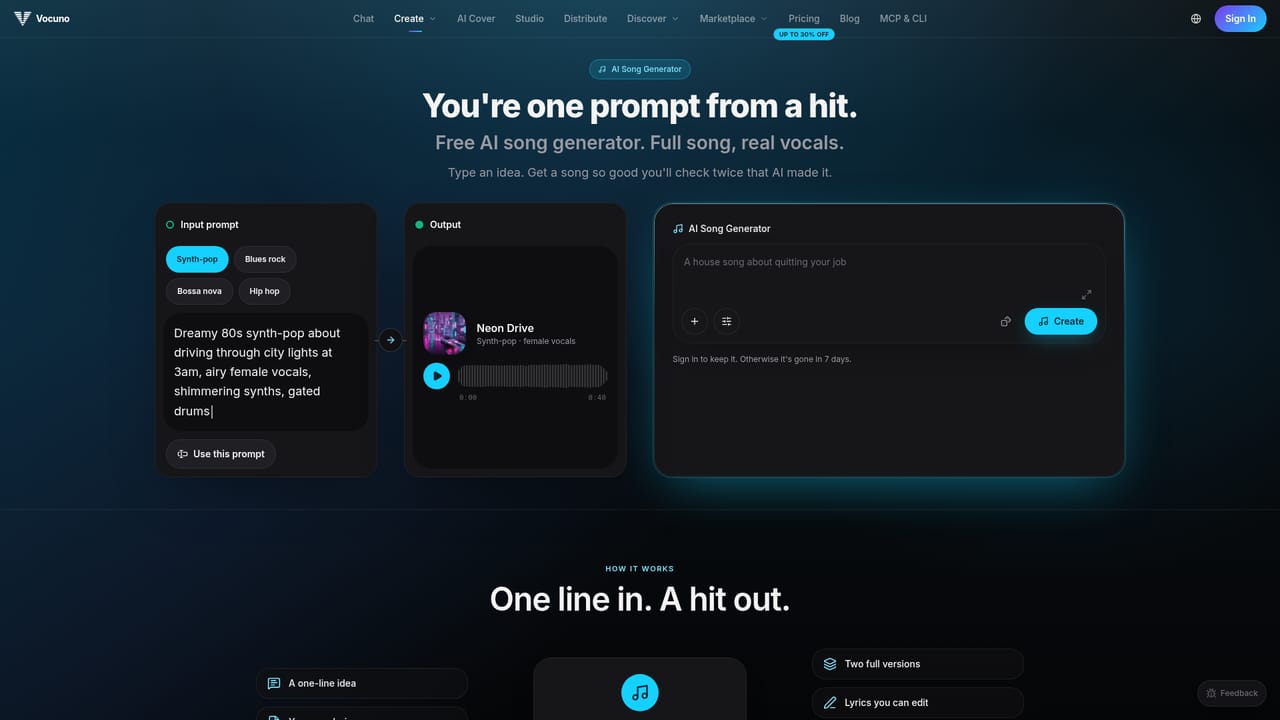
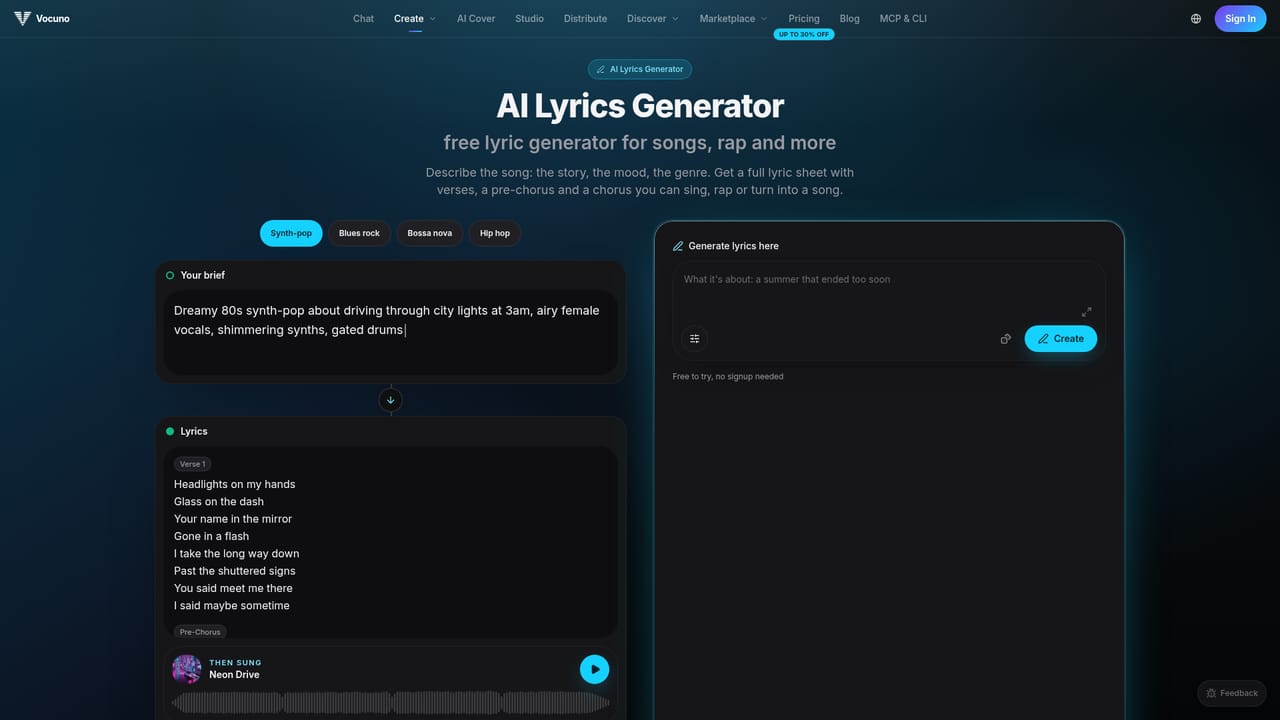
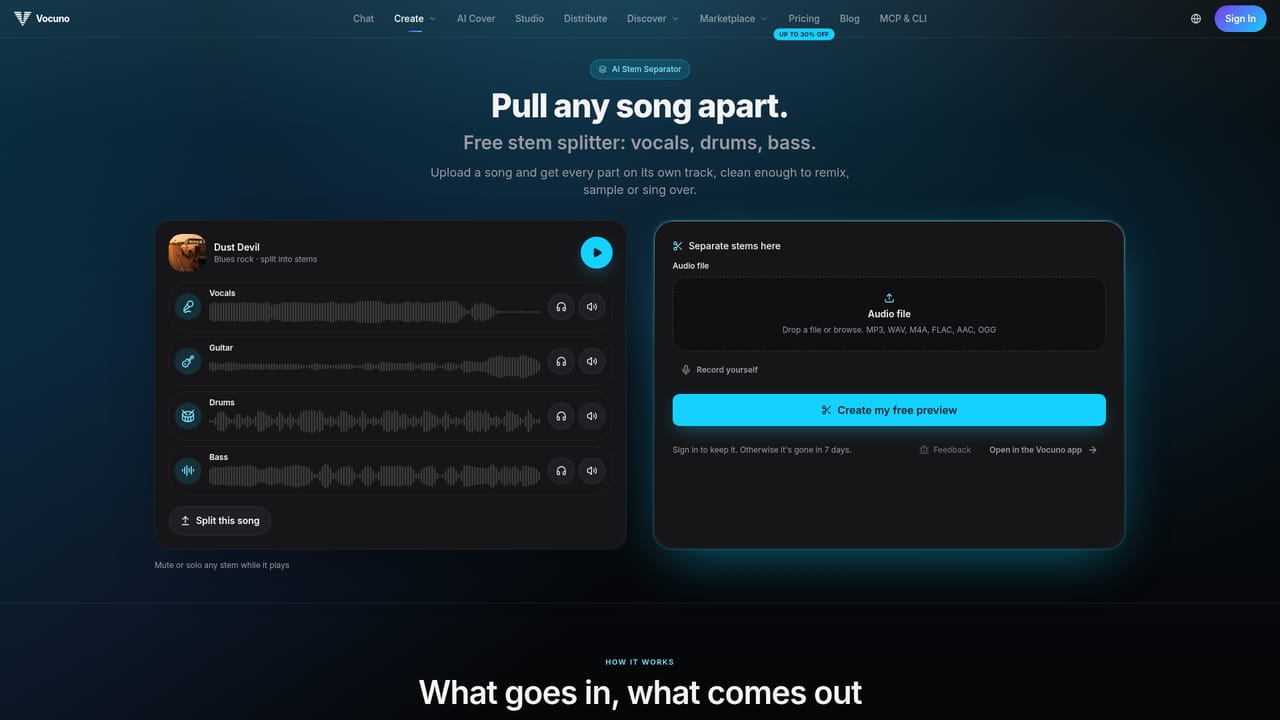
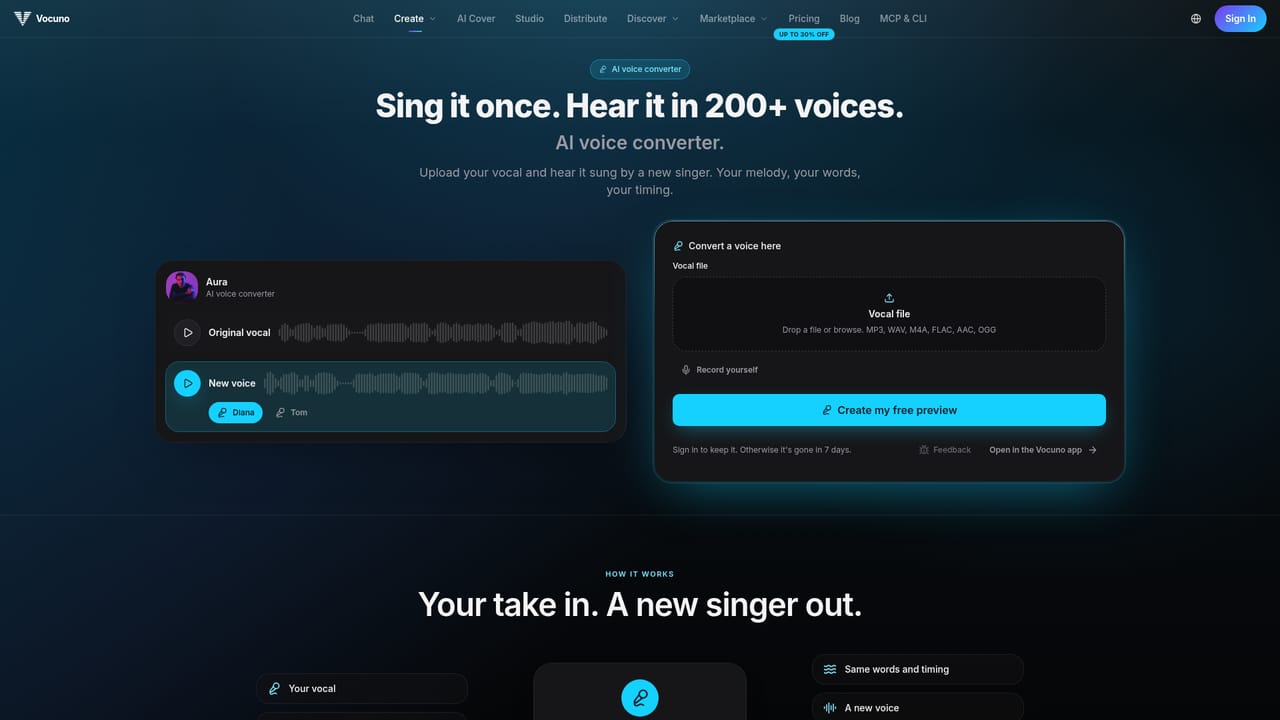
Vocuno is an audio editing tool. Vocuno bundles AI song generation, stem separation, voice conversion, lyrics writing and streaming distribution into a single music workflow, aimed at producers and lyricists who would rather not juggle several AI services to finish one track.
Vocuno is an AI music platform built around a single promise: everything a producer needs for a track sits in one place, so a session never has to be interrupted to go hunting for another tool. The core actions on the homepage are song creation, stem separation, voice conversion, lyrics generation, and distribution to streaming services. An AI cover tool, a studio workspace, a mobile app, and a model context protocol page round out the offering. The founder, a producer with a Spotify following, frames the product as the environment he wanted but could not find.
In practice the workflow is linear. A user starts with a prompt or a lyric sheet, generates a song, separates the result into individual stems for mixing, runs a voice conversion pass when a different vocal character is needed, and then exports or distributes. The homepage describes results that respond to a style prompt and lyric directions on the first pass. A comparison section positions the platform against Suno, Udio, ElevenLabs and Mureka, which suggests the intended pitch is consolidation: rather than subscribing to several specialist services, one account covers generation, vocal work and release.
Who it suits depends on how much of the chain someone needs. Hobbyists and lyricists who want finished tracks from their own words are clearly in scope; so are producers who treat AI output as raw material for mixing. The marketing leans hard on credible names, with artists credited at 1.1M, 858k, 375k and other monthly listener counts, plus a claimed cumulative 700M+ streams across the featured group and a combined audience above 5M monthly listeners. Those figures are the platform's own framing, not independently verified.
The trade-off is familiar for all in one music tools. Breadth invites comparison on the weakest stage rather than the strongest, and users with a settled workflow in one specialist tool may gain little by moving. It competes most directly with single purpose generators, where ease of consolidation is the argument rather than raw output fidelity.